Off-Grid Barn Conversion
How a £100k+ grid connection obstacle became a fully off-grid rural energy solution.
A real-world project combining solar PV, battery storage, backup generation and whole-house energy strategy.
Featured Project Video
Victron Energy case study · 285k+ views
AT A GLANCE
£100k+
Grid Connection Cost
500m
From Nearest Supply
Fully Off-Grid
Energy Solution
Monitored Since 2019
Continuous operational performance data
LPG Backup Generation
Integrated with the dual-fuel heating strategy
5-Bedroom Family Home
THE CHALLENGE
By the time I became involved, the barn conversion was nearing completion but a practical energy solution had not been finalised. The nearest viable grid connection was approximately 500 metres away, with estimated connection costs exceeding £100,000.
With the project under increasing pressure and no practical route to energisation, an alternative strategy was required that could support modern family living without compromising resilience, performance or long-term running costs.
Grid Infrastructure
The nearest viable grid connection point was approximately 500 metres away, resulting in a six-figure connection cost and significant project risk.
Rural Location
The property required a practical energy solution capable of supporting modern family life in a remote setting, including heating, hot water and everyday electrical demand.
Long-Term Resilience
The objective was not simply to reduce energy bills, but to create a dependable energy infrastructure designed around the long-term needs of the home.
THE STRATEGY
Rather than accept an excessive grid connection cost, the project was approached as a whole-house independent energy system.
The solution combined solar PV, battery storage, intelligent inverter architecture and backup generation capacity, integrated with modern heating systems and the wider demands of a rural home.
A dual-fuel approach was adopted to improve resilience and simplify logistics. The air source heat pump was capable of operating from either electricity or LPG, while the backup generator also utilised LPG. This allowed both heating and backup power requirements to be supported from a single fuel supply, reducing operational complexity and improving long-term practicality.
By treating energy as part of the overall build strategy , not an afterthought , the project could move forward with clarity, control and resilience.
THE SYSTEM
The energy system was designed as a complete, integrated solution rather than a collection of individual technologies. Each component was selected to work together, providing reliable power, resilience and long-term independence from a costly grid connection.
Solar Generation
Ground mounted solar PV provides the primary source of electrical energy, supporting everyday household demand throughout the year.
Battery Storage
Battery storage captures surplus solar generation and makes it available when needed, improving resilience and self-sufficiency.
Generator Backup
Backup generation provides security during prolonged periods of poor weather, ensuring continuity of supply.
Integrated Controls
Intelligent inverter and control systems coordinate generation, storage and backup power into a seamless energy infrastructure.
THE OUTCOME
What began as a £100,000+ grid connection obstacle became a fully operational off-grid energy system capable of supporting modern family living.
Nearly seven years later, the system continues to operate successfully, with long-term monitoring confirming the viability of the strategy and providing valuable operational insight.
The project demonstrates that, when approached as an integrated whole-house energy system, off-grid living can be both practical and resilient.
MEASURED PERFORMANCE
Unlike many published renewable energy projects, this system has been continuously monitored since July 2019.
The data provides insight into how an off-grid energy system performs across changing seasons, weather patterns and household demand over the long term.
More importantly, it provides real-world evidence that can be used to inform future energy strategies rather than relying solely on theoretical calculations.
WHAT THE DATA TELLS US
Seven years of operational data demonstrates that a properly designed off-grid energy system can successfully support modern family living without a grid connection.
The monitoring shows strong seasonal performance from the solar and battery system, with backup generation used primarily during periods of prolonged poor weather.
Rather than replacing one energy dependency with another, the system has delivered long-term resilience while maintaining practical day-to-day operation for a busy family home.
11,033 kWh
Annual Household Demand
Real measured electrical demand from a fully occupied five-bedroom family home.
~92%
RENEWABLE CONTRIBUTION
The majority of annual energy demand is supplied directly from solar generation and battery storage.
175-180 hrs
GENERATOR SUPPORT
Backup generation provides seasonal resilience during extended periods of poor weather.
Since July 2019
Continuous Monitoring
Long-term operational data provides insight into real-world off-grid system performance.
FROM MONITORED SYSTEMS TO FUTURE DESIGNS
This project forms part of my wider portfolio of more than 120 monitored grid-independent and standalone energy systems, with some performance records now extending beyond ten years.
That real-world data now informs my House Energy Modelling process.
HEM allows a future home to be modelled early in the design stage, then refined through the course of the build as the fabric, heating system, solar PV, battery storage, backup generation, EV charging and hot water strategy become clearer.
By combining engineering calculations with measured performance data, I can help assess how different design choices are likely to perform in practice — and optimise the house as one complete energy system before everything is fixed on site.
HEM INSIGHT
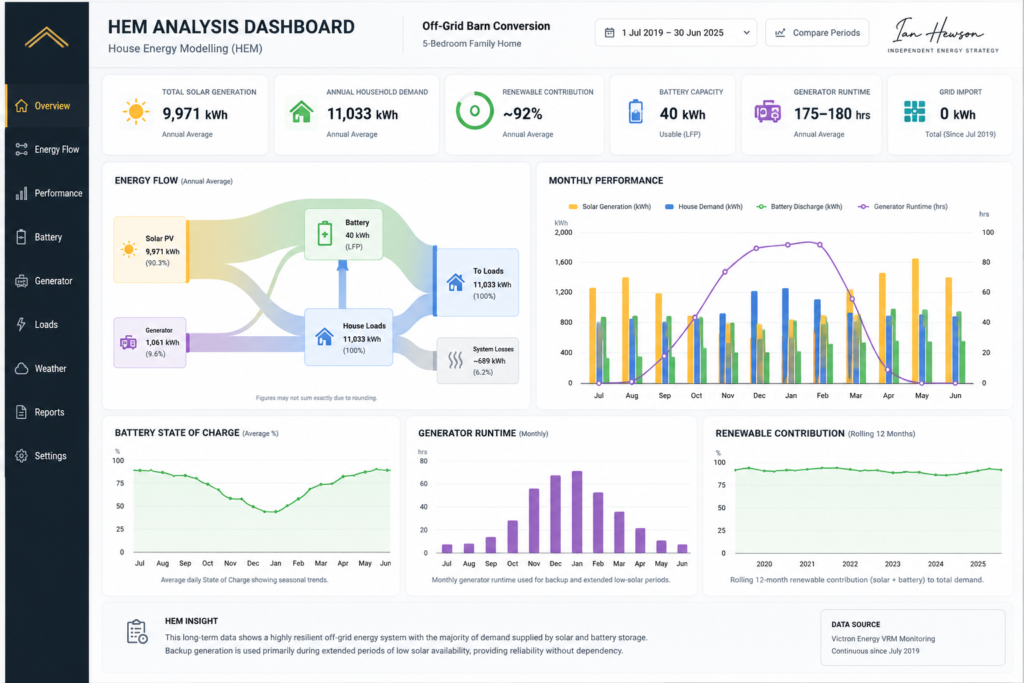
Example House Energy Modelling (HEM) analysis used to evaluate renewable contribution, battery behaviour, seasonal performance and backup power requirements before construction begins.
Role
My role is to guide the energy strategy from early feasibility through to the realities of the build.
I help clients understand what is possible, compare design options, model standalone performance and running costs, and optimise the house before key decisions are fixed.
As the project moves forward, I support the technical detail around contractors, installers, groundworks, system design, compliance, insurance and on-site problem solving.
The aim is simple: clearer decisions, fewer costly mistakes, less stress, and a home that works as one complete energy system.
START THE CONVERSATION
If you are planning a rural, self-build or off-grid home, send a brief outline of your project and what you’d like to achieve.
I personally review every enquiry and take on a limited number of projects each year.