Scottish Woodlands: Three-Phase Off-Grid Power
A 43 kWp solar, 91 kWh battery and 45 kVA three-phase system designed by Ian Hewson to avoid a difficult grid connection and support the long-term growth of a rural forestry business.
Scottish Woodlands Off-Grid Project Video
Featured by Victron Energy | 36,000+ views
Victron Energy documented the design, installation and testing of this three-phase off-grid system, including its operation under real commercial machinery loads.
AT A GLANCE
100 Acres
Rural forestry and training site
43 kWp
108 panel roof-mounted solar array
91 kWh
Lithium battery storage
45 kVA
Off-grid three-phase inverter capacity
60 kVA
Automatic backup generator
< 110 kVA
Combined inverter and generator capacity
THE CHALLENGE
Scottish Woodlands needed a reliable three-phase supply for a new workshop, welfare building and training facility on a 100-acre forestry site.
A conventional grid connection would have required a difficult cable route, likely including overhead lines across operational forestry land. This would have introduced safety and land-use constraints, affected future planting and reduced control over the site.
The brief was not simply to power the first building. The energy system needed to support machinery, welfare facilities, training operations and increasing demand as the site developed.
Grid Connection Constraints
The likely grid route would have brought overhead cables across working forestry land, affecting operations, safety, planting and future site use.
Commercial Three-Phase Demand
Workshop equipment, roller shutters and future machinery required a stable commercial three-phase supply.
Designed for Future Growth
The site’s electrical demand was expected to increase, so the system needed sufficient capacity, resilience and room for expansion.
THE STRATEGY
The project was approached as a whole-site energy strategy, not simply a solar and battery installation.
Ian Hewson assessed the current loads, three-phase requirements and likely future demand, then brought together the solar array, battery storage, inverter capacity and automatic generator support as one coordinated system.
The generator was integrated for extended periods of low solar generation and exceptional site demand. Normal day-to-day operation would be carried by the solar array, battery and three-phase inverter system.
This gave Scottish Woodlands a stable power supply that it could control, monitor and expand without relying on a conventional grid connection.
THE SYSTEM
The system combines solar generation, lithium battery storage, three-phase inverter capacity and automatic generator support.
Each part has a defined role: generate energy, store it, provide a stable three-phase supply and bring in backup support only when conditions require it.
The system was sized around the site’s operational needs and expected future growth, rather than only the initial building load.
SOLAR PV ARRAY
108 roof-mounted panels provided around 43 kWp of solar generation for the site.
Battery Storage
91 kWh of BYD lithium iron phosphate battery storage captures solar generation and supports the site outside solar-production hours.
Three-Phase Power
Three Victron 15 kVA Quattro inverter-chargers provide 45 kVA of stable off-grid three-phase capacity.
Automatic Generator Support
The inverter and generator capacity can work together to provide up to approximately 110 kVA of three-phase power when required.
THE OUTCOME
Scottish Woodlands gained reliable three-phase power without bringing overhead grid cables across its operational forestry land.
The system now supports the workshop, welfare building, training facilities, roller shutters and commercial machinery. A small standalone generator that had previously run throughout the day for the welfare building could be switched off.
The business also gained greater control over its energy costs, infrastructure and future development. Additional site loads could be considered without having to redesign the power strategy from the beginning.
“We’re delighted to be in a position where we’re in control. We have our own electricity and we feel we’ve future-proofed the business against outside influence.”
Scottish Woodlands
Early Feasibility
Assess grid constraints, site demand, three-phase requirements and practical off-grid options.
Energy Strategy
Coordinate generation, storage, backup power, future demand and operational resilience.
Technical Guidance
Support design teams and contractors through equipment decisions, installation planning and commissioning.
OPERATIONAL PROOF
The system has been continuously monitored since 31 August 2022, providing long-term evidence of how it performs under real site conditions.
During the 365 days to 30 July 2026, the site consumed 12,968 kWh of electricity. Of this, 40% was supplied directly by the solar array and 57% through the battery system.
Just 3% was delivered directly by the backup generator
WHAT THE PROJECT SHOWS
This project shows that off-grid energy is not limited to homes or small rural buildings.
With the right design, solar PV, battery storage, inverter capacity and backup generation can support a working commercial site with three-phase demand.
For Scottish Woodlands, the key result was control. The system avoided the constraints of a difficult grid route, reduced reliance on standalone generators and gave the business a power system that could grow with the site.
Continuously monitored since 31 August 2022
Source: Victron Energy VRM. Annual figures cover 31 July 2025 to 30 July 2026.
12,968 kWh
SITE ELECTRICITY CONSUMPTION
Recorded during the 365 days to 30 July 2026.
97%
SOLAR OR BATTERY SUPPLY
Electricity delivered directly from solar or through battery storage.
3%
DIRECT GENERATOR SUPPLY
Only 415 kWh was delivered directly from the generator.
0 kWh
GRID IMPORT
The site operates without a mains electricity connection.
HOW THIS EXPERIENCE INFORMS FUTURE PROJECTS
Real projects provide evidence that design models alone cannot.
Long-term monitoring shows how solar generation, battery storage, inverter capacity, site demand and generator support interact under changing weather and real operational conditions.
I use that experience to help rural businesses, farms, estates, workshops and landowners assess whether an independent energy system is practical before they commit to equipment, grid infrastructure or major construction work.
The process starts with the site, the loads, the grid constraints, future demand and the required level of resilience. Equipment selection comes later.
COMMERCIAL DESIGN INSIGHT
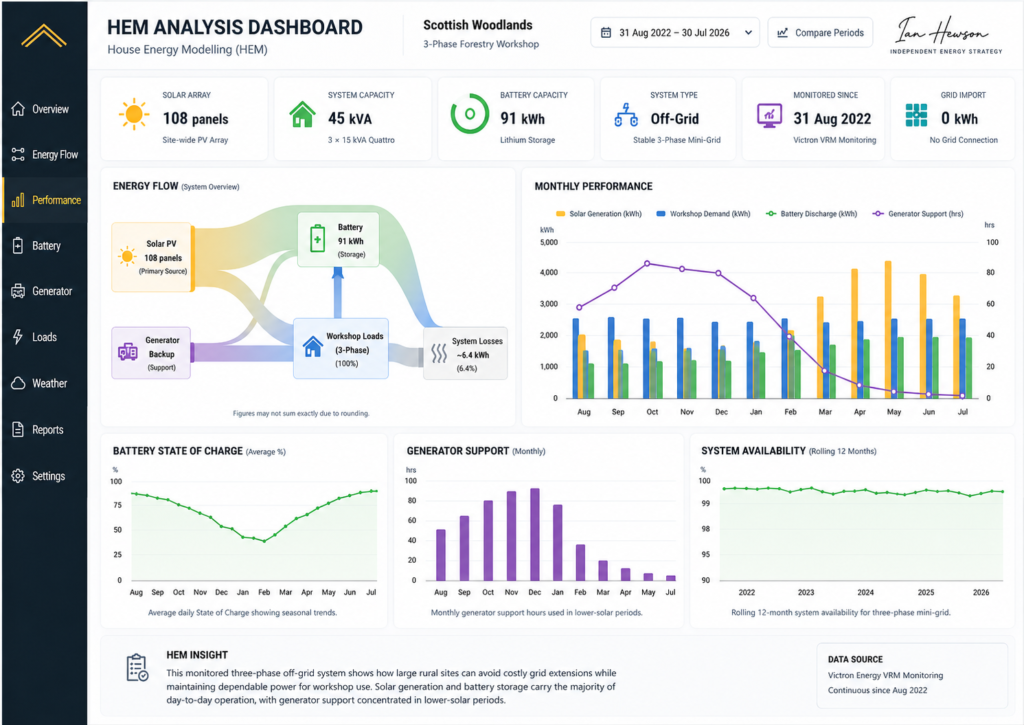
Example House HEM analysis used to evaluate renewable contribution, battery behaviour, seasonal performance and backup power requirements before construction begins.
My Role in the Project
I led the energy-system design and helped bring together the delivery team through Off Grid Engineering.
My work included assessing the site’s present and future power demand, defining the required three-phase capacity and coordinating the solar, battery, inverter and generator strategy as one complete system.
The design then had to be carried through installation, commissioning and testing against real commercial machinery loads.
Today, I use that practical experience as an independent energy strategy consultant. I help clients determine what is possible, what capacity is genuinely required and where the main technical and financial risks lie before major decisions are fixed.
“Ian has taken that forward with the design and brought the whole team together.”
Scottish Woodlands
Discuss Your Project
If you are assessing a difficult grid connection, planning a rural commercial site or considering independent three-phase power, send me a brief outline of the project.
I can help you assess what is practical, compare the available options and identify the main risks before you commit to infrastructure or equipment.
I personally review every enquiry and take on a limited number of projects at a time.